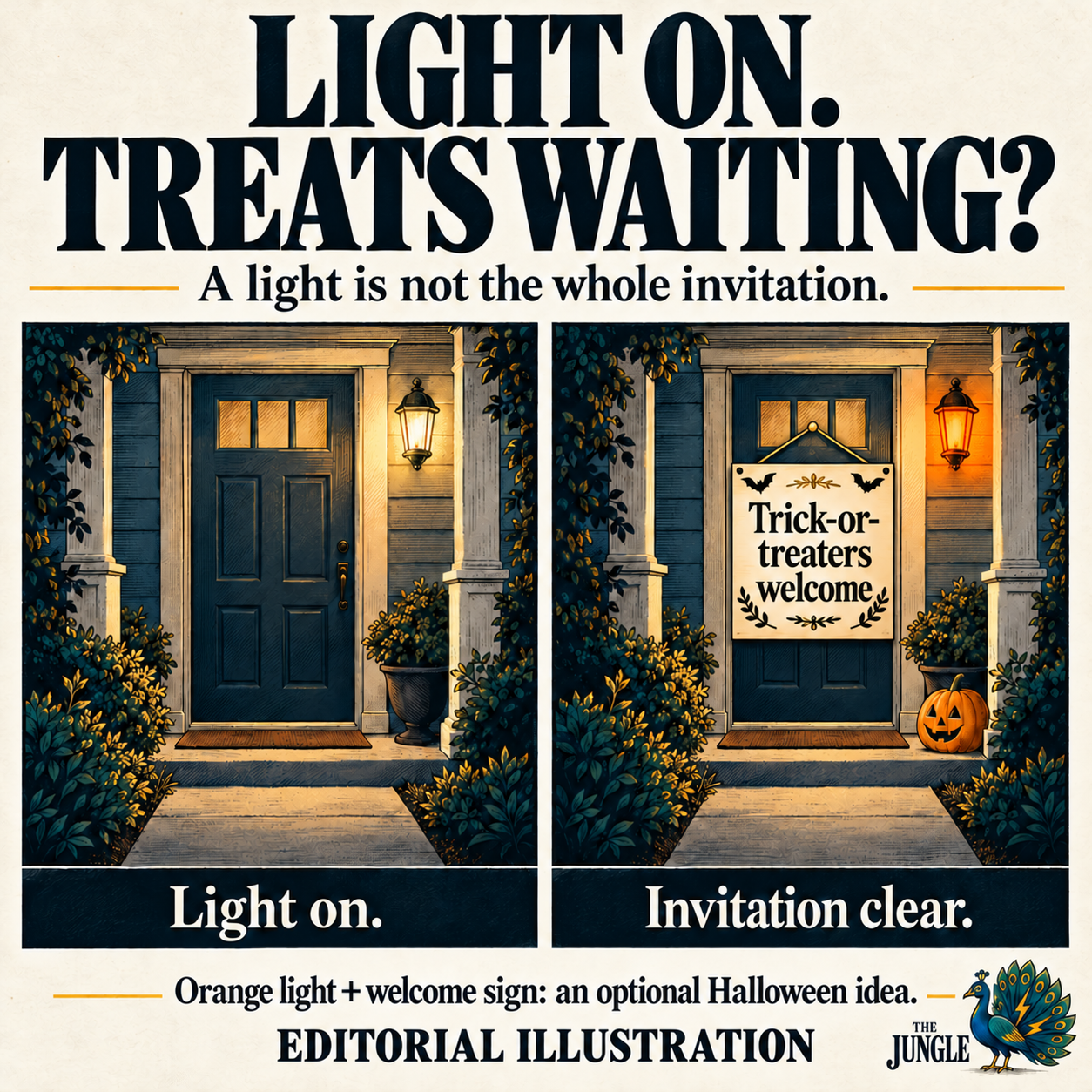
A porch light can help a child find the front steps. Can it also reliably tell a family that someone is waiting behind the door with candy?
Halloween advice gives the light an important role. The American Academy of Pediatrics tells families to visit homes with a porch light on, preferably with an illuminated approach. That is useful safety guidance. It is not a promise that every illuminated home is participating. A light can also serve an ordinary evening purpose: helping someone get home, showing a delivery driver the entrance or lighting a walkway. The difference matters when the same bulb is expected to do two jobs. American Academy of Pediatrics
For Jungle-area households, the most useful improvement may not be a replacement light bulb. It may be a few clear words beside the light. The following are optional ideas to try, not an official St. Petersburg rule, a neighborhood agreement or a newly established code.
Keep the light. Add the invitation.
The simplest option is a reusable sign reading “Trick-or-treaters welcome.” A large pumpkin outline could help someone spot it, but the words would carry the meaning. Put it where it can be read from the normal approach without asking visitors to cross a lawn or enter a dark path. A door or front window may work better than a sign tucked behind decorations.
A second option is a two-sided sign: “Treats available” while the household is participating, then “Finished for tonight, happy Halloween.” That gives a family a useful answer when a bowl runs empty or a host needs to stop. It also avoids making darkness the only way to say no. People who need their exterior lights should not have to sacrifice that function to end the evening.
A third option is a visible, attended treat station on the household's own property, if space and access allow. A sign can point to the station rather than the front door. This is a possible arrangement, not a claim that any particular Jungle home has a step-free route. Keep the invitation accurate: “Treats here” is more useful than an accessibility promise the host has not checked.
For households that want a shared design, a simple pumpkin-and-door symbol could accompany the same written invitation. Neighbors could voluntarily use it, but visitors should not need to have read a social-media post to understand it. Until a symbol has a genuinely shared meaning, its job is to attract attention to the words, not to replace them.
An orange bulb can help. Words carry the invitation.
For households that want a festive cue, we propose an optional orange porch bulb alongside a clear “Trick-or-treaters welcome” sign. The orange light is a suggested design choice, not an established St. Petersburg rule or a universal promise of treats. Keep the approach well lit; an orange glow should not replace lighting needed to see steps, obstacles or the path. Security and emergency lighting should keep their ordinary purpose.
There is already a well-established Halloween symbol with a narrower meaning. FARE's Teal Pumpkin Project uses a teal pumpkin or sign to indicate that non-food treats are available. That does not mean every treat at the home is suitable for every child; FARE advises keeping food and non-food offerings in separate bowls. A general welcome sign can sit alongside that specific information without borrowing or changing the teal pumpkin's meaning. FARE, About the Teal Pumpkin Project
Make the message easy to stop, and easy to skip
The strongest argument for the porch-light tradition is simplicity. It costs nothing extra for many households and is already included in familiar safety advice. Adding a sign should not turn a casual holiday into another purchase or participation test. Hand-lettered words can do the work; a coordinated design is optional.
Nor should a household have to explain why it is not participating. A visible “Not participating tonight” message is an option, not a requirement. Families can respect that answer without inferring anything about who is home or why.
Whatever the signal, the practical welcome still matters. The pediatricians' guidance includes clearing tripping hazards, checking exterior lights and keeping pets from jumping on visitors. A clever symbol cannot substitute for a usable approach. American Academy of Pediatrics
The modest proposal is a light for seeing and words for understanding. Keep the familiar cue; make the invitation explicit. That leaves room for Halloween spontaneity without asking one porch bulb to explain the whole evening.
STRAIGHT TO THE SOURCE
SOURCES & RECORDS.
Original reporting and document review by The Jungle. Sources checked October 29, 2026.