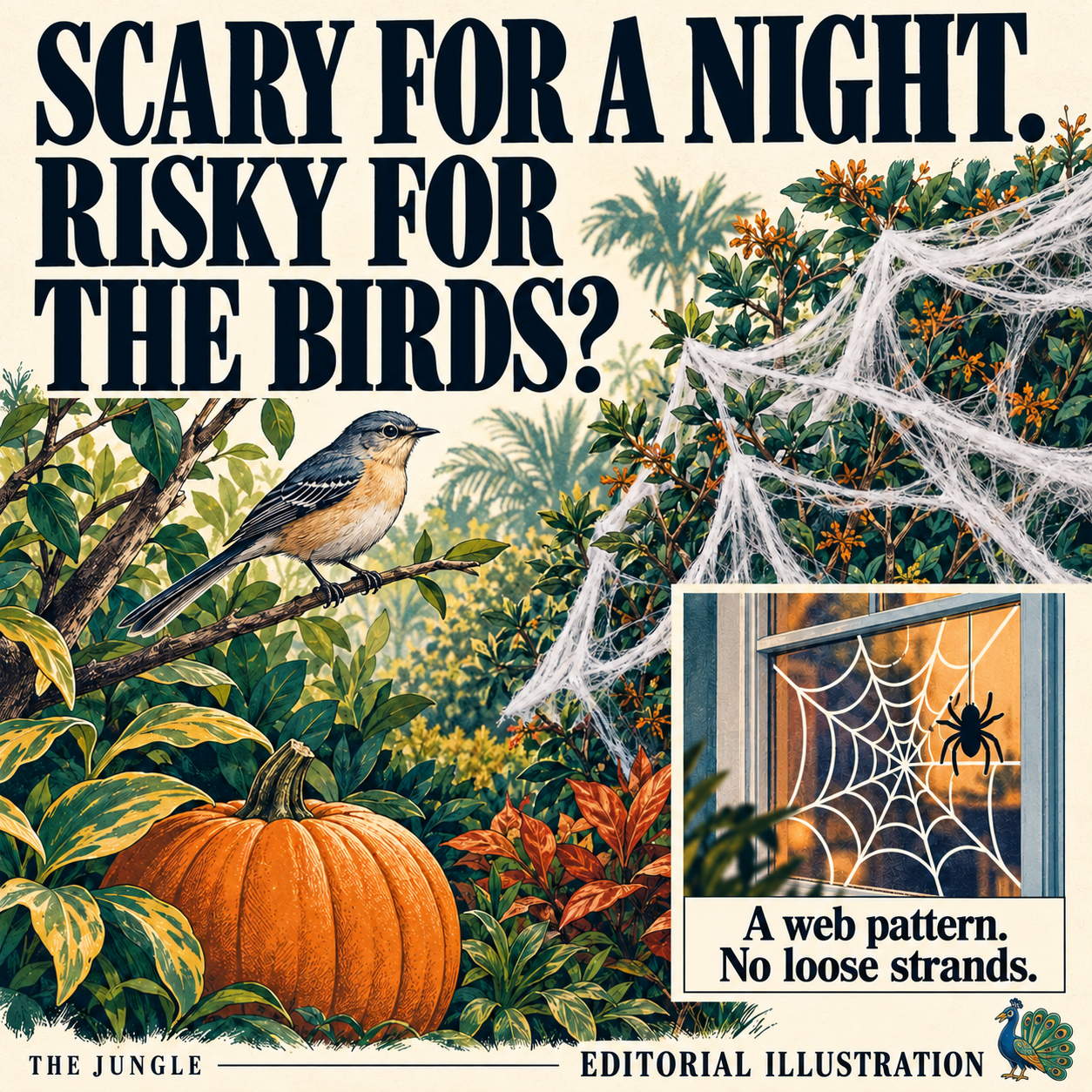
The artificial web stretched across a shrub is meant to look like something a spider left behind. For a bird moving through the same space, the decoration can be more than scenery.
The University of Illinois Wildlife Medical Clinic identifies stringy fake cobwebs and loops as entanglement hazards. The Canadian Wildlife Federation also warns that animals may be unable to break free of artificial webbing. These are warnings about materials and placement, not evidence that every decorated yard injures wildlife. University of Illinois Wildlife Medical Clinic; Canadian Wildlife Federation
That distinction is important around Park Street and the residential edges of Abercrombie Park, which the City places at Park Street and 38th Avenue North. The location makes this a relevant question to examine locally. It does not establish that particular households are using hazardous decorations or that a bird has been injured there. No such incident or property-level finding has been verified for this article. St. Petersburg Parks & Recreation, historic sites
Change the setting, not the celebration
The useful question is not whether a yard should look festive. It is whether the same effect can be achieved without loose strands in a space animals can enter.
A web drawn on a solid panel offers the pattern without a three-dimensional tangle. A paper spider displayed inside a window keeps the joke visible from outdoors. A freestanding, solid decoration can supply a focal point without wrapping vegetation. These are design alternatives, not products tested or certified as wildlife-safe. Their advantage is specific: the proposed versions do not require loose webbing across branches.
For a household that already owns a box of decorations, the first change need not be buying replacements. Sort the materials by form. Which pieces are solid? Which have dangling loops or fine strands? Which could be shown through a window instead? The Illinois clinic suggests that stringy or looped decorations may be better displayed indoors. Any indoor placement still needs to account for children and pets. University of Illinois Wildlife Medical Clinic
Calling a material natural, reusable or biodegradable does not answer the entanglement question. In choosing an alternative, look at its physical shape and where it will sit, rather than treating an appealing label as a safety guarantee. A solid cutout and a loose cord are different designs even if both are made from familiar household materials.
Don't forget what holds it up
The decoration itself is only part of the display. Hanging parts, loops and supports deserve a look, too. In separate guidance, the Illinois clinic advises against outdoor decorations with small holes or loops that can catch an animal, and recommends placing signs or décor inside windows. Moving a display means considering the whole assembly, not simply replacing one stretchy material with another. University of Illinois, Wildlife Friendly Halloween Decorations
Before adding another item, consider the whole layout: the route to the door, the vegetation, the hanging supports and where the display will be stored afterward. A smaller arrangement in a visible place can still be welcoming. Reusing solid pieces indoors or in a more controlled setting preserves both the investment and the holiday effort.
If an animal is caught
Florida's Fish and Wildlife Conservation Commission directs people who find apparently injured wildlife to note the location and contact a licensed wildlife rehabilitator. Its directory identifies rehabilitators by county and the types of animals they handle. Availability varies, so a listing is not a promise of immediate pickup or admission. Follow the professional's instructions rather than trying an improvised treatment. FWC, injured and orphaned wildlife
How often does this happen? The Canadian Wildlife Federation acknowledges uncertainty about the frequency even while explaining that entanglements occur. That is a useful limit: a hazard warning is not a local injury count. A photograph of a web on a bush would not, by itself, prove harm. Nor would an absence of visible injuries prove a design harmless. Canadian Wildlife Federation
The available guidance supports a smaller, useful conclusion now: outdoor artificial webbing creates an avoidable entanglement concern, and the spooky look does not require putting strands where wildlife can encounter them. Keep the pumpkin, the joke and the invitation. Rethink the tangle.
STRAIGHT TO THE SOURCE
SOURCES & RECORDS.
Original reporting and document review by The Jungle. Sources checked October 29, 2026.