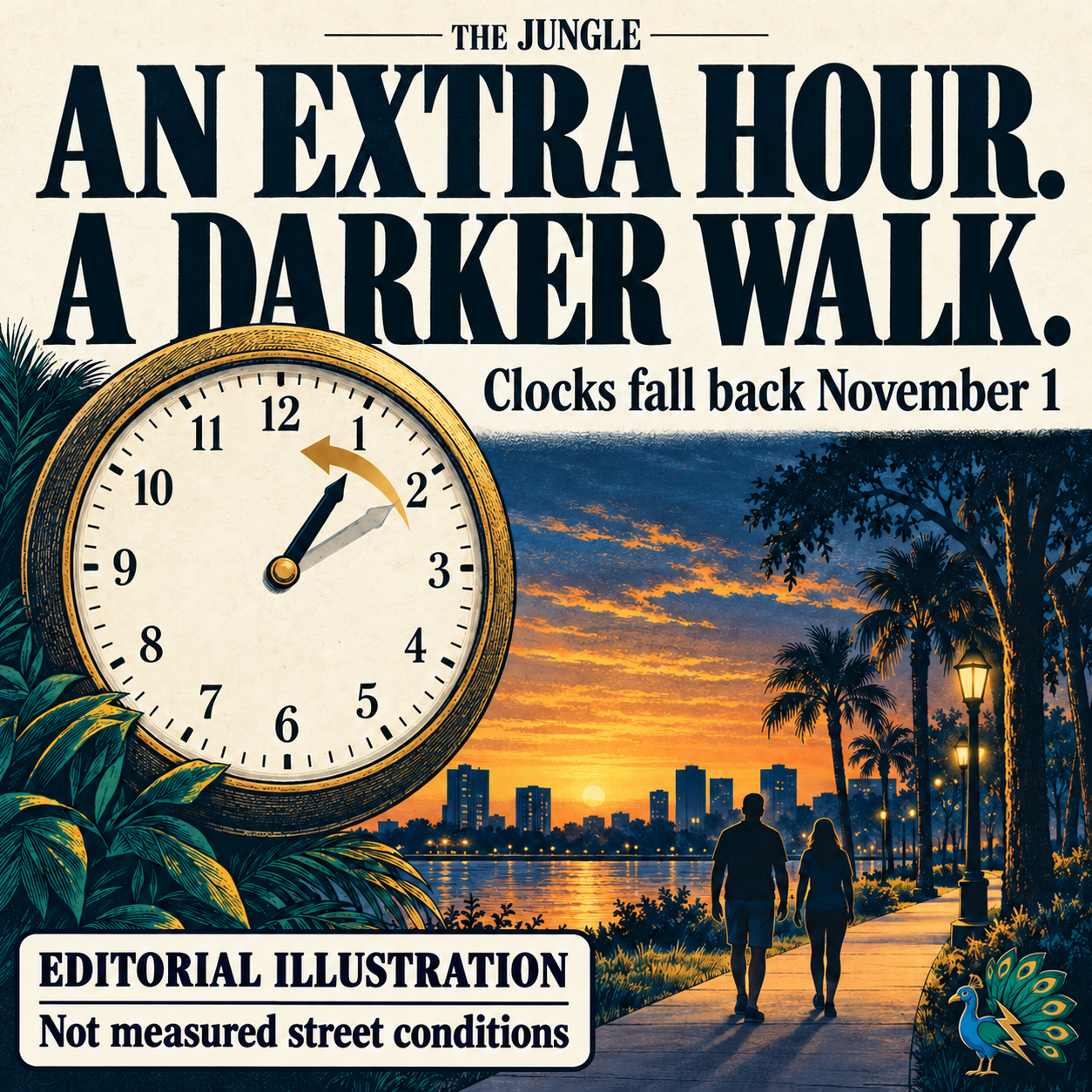
When clocks move back on November 1, the after-work trip does not automatically change with them.
Daylight saving time ends Sunday, November 1, 2026, at 2 a.m. local time. Clocks move back to 1 a.m., repeating an hour. For someone leaving at the same clock time in the evening, daylight will be further along than it was under the previous setting. The change does not remove an hour of sunlight from the sky; it changes which clock hours contain it. National Institute of Standards and Technology
That is the basic before-and-after comparison for an evening walk on 38th Avenue North or Park Street. An outing beginning at 6 p.m. after the change lines up approximately with the sun's position at 7 p.m. under the old clock, apart from the ordinary day-to-day seasonal change. This is a clock-based explanation, not a measured light reading or a claim that every part of either street has the same visibility.
The local geography is real: the City's listing places Abercrombie Park at Park Street and 38th Avenue North. But naming the junction is not an inspection of its crossings, fixtures or sidewalks. This article does not report a failed streetlight, unsafe intersection or newly discovered crash cluster there. Those findings would require separate evidence. St. Petersburg Parks & Recreation
Seeing the road is not the same as seeing a person
A street can look illuminated while a person waiting to cross remains difficult to distinguish. Federal Highway Administration guidance emphasizes how light reaches pedestrians, not just whether a lamp is present. Its crossing guidance describes placing lighting in advance of crossings so it illuminates people from the sides instead of creating overhead shadows. It also calls for limiting glare. FHWA, Step Up for Pedestrians at Night
That makes “add a brighter light” an incomplete answer. The relevant questions include whether someone at the crossing is visible, whether glare interferes with the view and whether lighting spills into adjacent homes. FHWA's lighting guidance recognizes that modern fixtures can direct light more precisely and limit unwanted spill. A safety improvement and a neighbor's wish for a darker bedroom need not be treated as incompatible demands. FHWA, Lighting
The same trip, checked differently
For a useful comparison, hold the journey constant: the same start point, destination, direction and clock time. Then distinguish what changes. The time shift is predictable; weather, traffic, functioning lights and temporary obstructions are not. A photograph from one evening cannot separate all those factors.
Someone considering an evening route can look at the whole journey rather than the brightest section: where the crossing happens, where vehicles turn across the path and whether the approach is clear. A shorter route is not necessarily the easiest to use; a longer alternative is not automatically safe. Neither should be certified from a desktop map alone.
Drivers have responsibilities in this transition, too. The National Highway Traffic Safety Administration advises extra caution at night, slowing when turning into a crosswalk and never passing a vehicle stopped at a crossing. For people walking, it recommends sidewalks where available, crossings at intersections or crosswalks, and watching for vehicles entering or leaving driveways. These measures complement a well-designed street; they do not replace one. NHTSA, pedestrian safety
What would establish a local problem?
A useful report starts with a specific public place and a specific difficulty: “The person waiting on this side is hard to see when approaching from that direction,” for example. That is a reporting template, not an incident observed here. Add the time and conditions, then establish who maintains the relevant road, signal or light before assigning responsibility.
The distinction between an outage and a design concern also matters. A light that has stopped working presents a different question from a functioning light that leaves a crossing hard to see. Neither observation by itself establishes the cause. Describing the specific difficulty is more useful than asking for the entire street to be made brighter, especially when glare may be part of the problem.
There is another side to the clock change: morning daylight shifts earlier by the clock, so some morning trips may benefit. Whether that helps a particular trip depends on when it happens. The point is not that standard time makes every journey worse. It is that an evening routine deserves another look when its relationship to daylight changes.
On 38th Avenue North and Park Street, the next question is concrete: not whether the whole neighborhood is “too dark,” but which public part of a real trip is difficult to see, in what conditions, and what evidence would help explain why.
STRAIGHT TO THE SOURCE
SOURCES & RECORDS.
Original reporting and document review by The Jungle. Sources checked October 29, 2026.