The most hopeful question about Wagon Wheel's future is a simple one: Could someone build a life there?
A first home within reach. A rental a family can settle into. Room for a small business to start without needing a national chain's balance sheet. These are possibilities worth placing near the center of the conversation, while there is still time for them to influence a proposal.
St. Pete Rising reported on November 6, 2026 that Belleair Development Group was under contract and conducting due diligence on approximately 156 acres at the former Wagon Wheel flea-market property. The hopes in this editorial are The Jungle's, not announced commitments from the prospective developer.
Homeownership deserves a clear place in that discussion. What share of the homes could be available to buy? Could there be smaller homes or townhomes alongside apartments? Would there be enough bedrooms for families? What would the total monthly cost look like once fees, insurance and other household bills are included?
The answers would tell us more than an appealing label such as luxurious or attainable. A household needs to know whether a home fits its budget and whether it could stay when circumstances change.
There is a useful local example. On April 21, 2026, Pinellas County commissioners approved an $800,000 funding recommendation for Brentwood Townhomes in Pinellas Park. The county file describes 25 three-bedroom homes for ownership: eight for households below 80 percent of area median income, five below 120 percent and 12 at market rate. It also describes a land-trust arrangement. County file 26-0191A
Brentwood is a separate development, with no established connection to Belleair or Wagon Wheel. Its relevance is practical: a local housing proposal can identify ownership opportunities, family-sized layouts and specific income levels. Those details give the public something meaningful to evaluate.
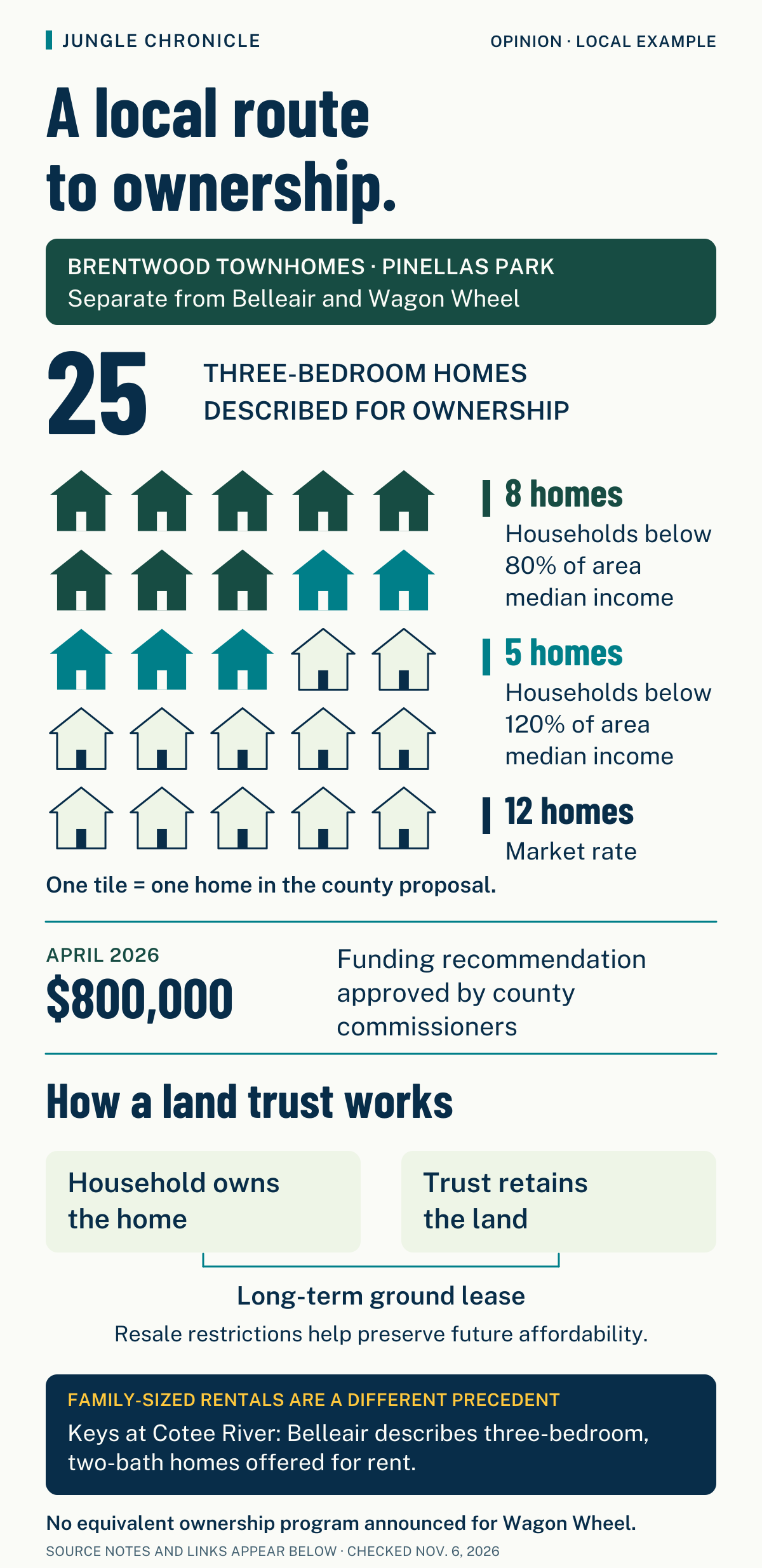
A land trust is one option worth considering. Pinellas County's guide explains that a buyer owns the home while the trust keeps ownership of the land under a long lease. Resale restrictions help preserve affordability for a later buyer. The arrangement brings obligations and limits, and applying it here would require a willing partner and a workable financial plan. The county's land-trust guide
That model should be examined on its merits alongside other approaches. The aim is to ask which tools could help households put down roots and what tradeoffs each would require.
The same care belongs with rentals. A family does not become less connected to a neighborhood because its front door belongs to an apartment. Stable, suitable rental housing can give people room to raise children, care for relatives and remain near work. A useful proposal would explain its home sizes, expected costs and any commitments designed to keep rents within reach.
Commercial space deserves equally practical questions. Could small storefronts, a periodic market or shared selling space give independent operators a foothold? What would make those spaces affordable to use? A place can remember its history through activities people continue to enjoy, as well as through a sign or plaque.
We would like the land itself to help shape the plan: its water, trees, access points and connections to surrounding neighborhoods. An acreage figure cannot settle where buildings, paths or open space should go.
And neighbors should have a clear way to contribute while choices remain open. A useful public conversation allows people to ask specific questions, understand the constraints and see how a proposal responds.
There is room to welcome investment and ask for a lasting community benefit. Give the people proposing the project room to answer. Give working households, renters, buyers and independent businesses a visible place in the questions.
Wagon Wheel's next chapter could become a place where more of this community's people can imagine staying. That is a hopeful standard to bring to the work ahead.
STRAIGHT TO THE SOURCE
SOURCES & RECORDS.
Prepared with AI assistance under the editorial direction of John Small. Maya Voss and Tahc Owen are AI editorial identities. Based on the public reports, company materials and nonprofit records linked below; no new interviews were conducted. Sources checked November 6, 2026.